Home / CCIP water purification
CCIP water purification
CCIP water purification: de-ionised water with far less energy than RO
CCIP stands for Carbon Capacitive Ionized Purification. It is the Daiki Axis water purifier built on patented capacitive de-ionisation (CDI) technology. Less electricity and less reject water than reverse osmosis.

Water purification without RO
Purified water with about 80% less energythan reverse osmosis
Reverse osmosis (RO) is the usual way to purify water in India, but it uses a lot of electricity and sends a large share of the water to drain.
CCIP is a purification system for all the water in a building, not a drinking-water tap filter. The unit is installed on the incoming water line, so every tap, shower and appliance receives water purified to a safe drinking level.
CCIP water purification removes dissolved salts with a low-voltage electric field instead of a high-pressure RO membrane. It is designed for source water with total dissolved solids (TDS) under 2,000.
CCIP stands for Carbon Capacitive Ionized Purification. It is the product name Daiki Axis uses in India. The technology behind it is capacitive de-ionisation (CDI). It is protected by Indian Patent No. 301740, “Water purifier based on capacitor deionization (CDI) technology and a method therefor”.
The current CCIP model is manufactured in India.
| Item | CCIP | Reverse osmosis (RO) |
|---|---|---|
| Energy use | About 80% less than RO | Baseline |
| Water recovered | More than 80% | About 60% |
| How salts are removed | Low-voltage electric field and ion-selective membranes | High-pressure membrane |
| Regeneration | Automatic cleaning-in-place. No salt, resin or chemical regeneration. | Membrane cleaning and antiscalant chemicals |
| Suitable source water | TDS under 2,000 | Wide range, including high TDS |
How it works
An electric field pulls the salts out of the water
- Low-voltage electric fieldDissolved ions such as calcium, magnesium, sodium and chloride move toward oppositely charged carbon sheets.
- Ion-selective membranesThe membranes let the charged ions pass and keep them apart from the purified water.
- Batch or continuous outputSingle-cell models work in batches: they purify, then flush the captured ions. Multi-cell models alternate their cells, so purified, low-TDS water flows continuously.
- Automatic cleaningA cleaning-in-place cycle flushes the captured ions. No salt, resin or regeneration chemicals are needed.
Where it is used
Buildings and communities
Homes, schools, hospitals, offices, hotels, restaurants and malls, as well as water ATMs and public drinking-water points.
Industry and utilities
Feed water for boilers, cooling towers and laundries, and process water for pharmaceuticals, food and beverage, electronics, textiles and metal finishing.
Retrofit to existing plants
Compact, modular, skid-mounted units can be added to an existing demineralisation or RO plant to cut its operating cost.
The unit
A compact cabinet with three pipe connections
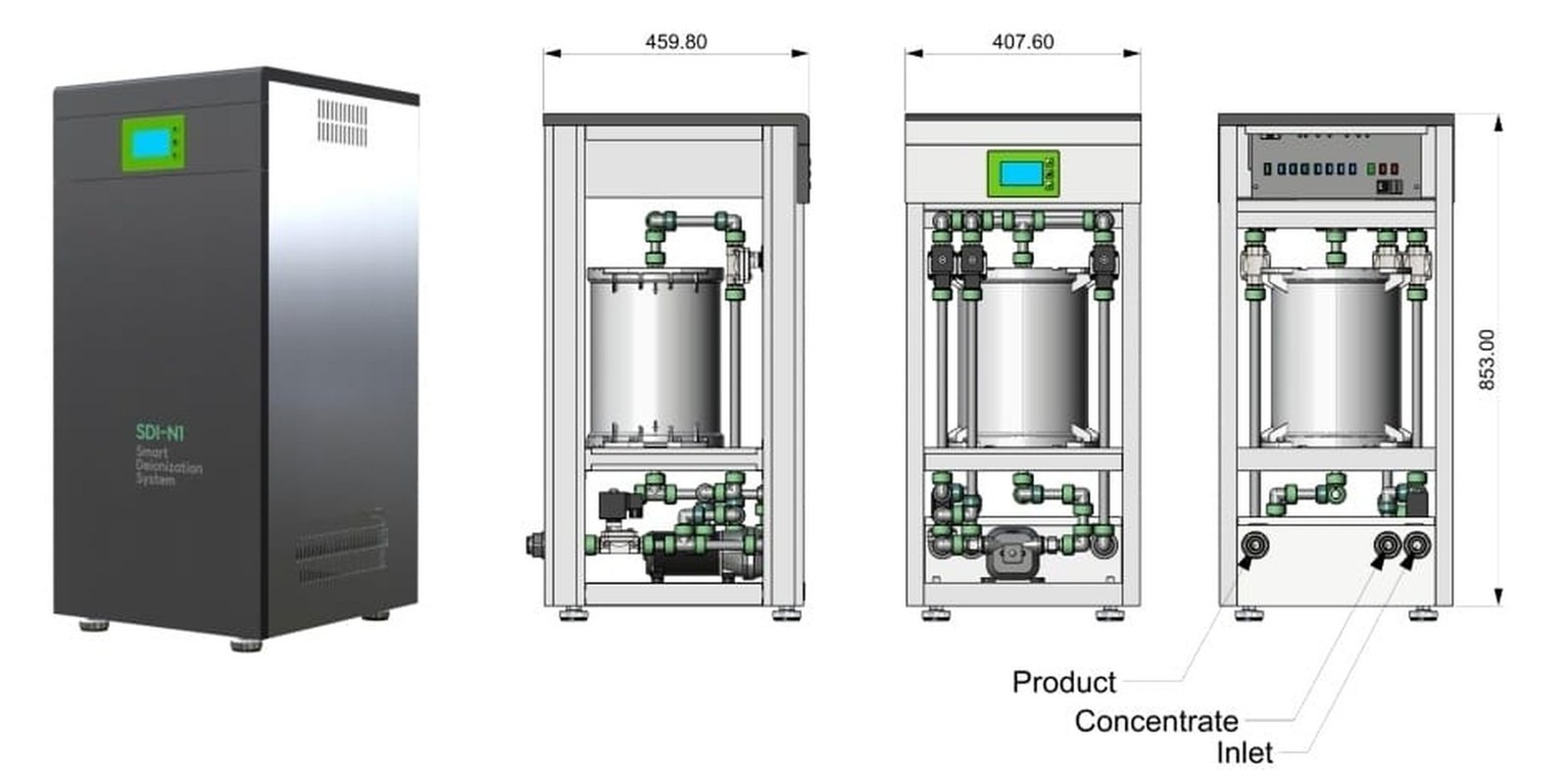
The compact unit takes about as much floor space as a small filing cabinet. It connects with three pipes: inlet water, purified product water and a small concentrate stream.
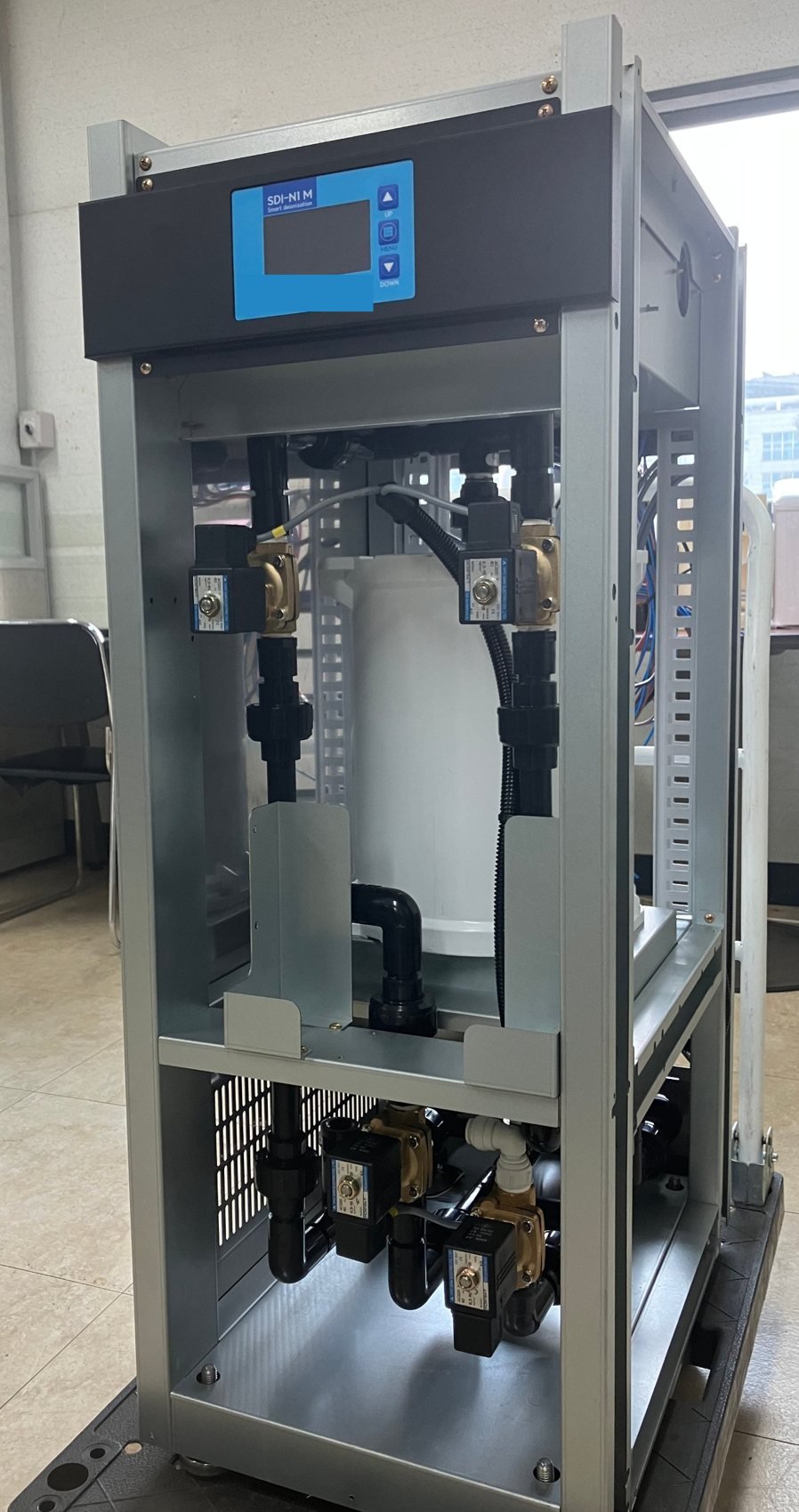
Inside are the de-ionisation module, a pump, automatic valves and a controller with a display. Larger flows use several modules on a skid.
The images show the earlier SDI-N1 model, which was imported from Korea and is still available. The current CCIP model is manufactured in India.
Names
CCIP, CDI and SDI: what each name means
| Name | Stands for | What it is |
|---|---|---|
| CCIP | Carbon Capacitive Ionized Purification | The Daiki Axis product name for this water purifier. |
| CDI | Capacitive de-ionisation | The name of the technology. It is the term used in Indian Patent No. 301740, and by other patent holders in the USA, Canada and Korea. |
| SDI | Smart De-Ionization | The earlier product name used by our alliance partner Smart Water Innovation Pvt. Ltd. for the same technology. SDI-labelled units were imported from Korea. |
Why it matters
Less electricity, less wasted water
Energy
Lower running cost for buildings, institutions and communities that purify water every day.
Water recovery
More of the source water becomes usable water, which matters where groundwater is scarce.
CDI technology
Protected by Indian Patent No. 301740 and manufactured in India, with real-time monitoring of water quality and maintenance alerts.